Do you know that Free radicals are unable and highly reactive molecules in your body that can cause cell damage?
Your body produces free radicals as a byproduct of metabolism or oxidation.
Moreover, it may also produce free radicals as a result of exposure to toxins in the environment.
These can be tobacco smoke and ultraviolet light.
It is important to note that free radicals have a lifespan of only a fraction of a second.
However, during this time, they can damage your DNA, and in some cases, result in mutations that can lead to cancer.
Antioxidants on the other hand can help to neutralize the unstable molecules, thus, reducing the risk of such damage.
Keep on reading to learn more about it in detail.
Understanding Free Radicals
In order to understand Free Radicals, you only need basic knowledge of chemistry.
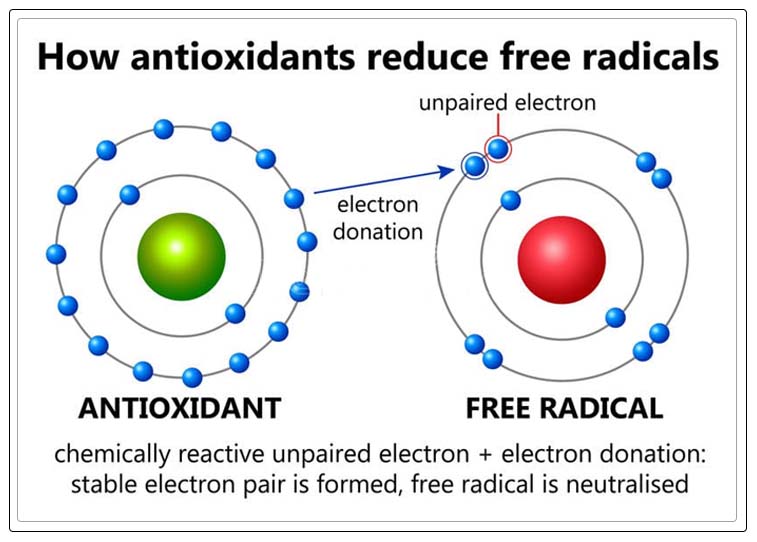
Electrons surround the atoms that orbit it in layers: Shell.
Each shell needs to fill in a fixed set of electrons and when a shell is full, electrons begin to fill in the next shell.
In case the atom has an outer shell that is not full, it may bond with another atom.
 Thus, using the electrons to complete its outer shell.
Moreover, these types of atoms are called Free Radicals.
Atoms with a full outer shell are stable, however, free radicals are unable.
In an effort to make up the number of electrons in their outer shell, they react quickly with other substances.
When oxygen molecules split into single atoms, they have unpaired electrons.
They become unstable free radicals that look out for other atoms or molecules to bond with.
If this continues, it begins a process: Oxidative Stress.
This oxidative stress can damage the cells in your body, thus leading to a number of diseases.
It can also cause symptoms of aging like wrinkles.
Sources of Free Radicals
You might be wondering where these free radicals come from.
Your body produces free radicals in different ways.
As already mentioned above, they may come from the normal metabolic process in the body or by exposure to carcinogens.
Carcinogens are cancer-causing substances in the body.
Free Radicals due to Normal Metabolic Processes
Your body produces free radicals in the process of breaking down nutrients to create the energy which allows the body to function.
 Moreover, the production of free radicals in normal metabolic processes is one of the reasons that the risk of cancer increases.
It also increases as you age, and when you have exposure to cancer-causing substances.
Free Radicals due to Exposure to Carcinogens
An important thing to note this that exposure to carcinogens in the environment can also produce free radicals.
Examples of certain carcinogens are:
- tobacco smoke
- ultraviolet radication
- some types of viruses
- radon in your home
- medical radiation
- air pollution
- environmental and occupational substances and chemicals like asbestos and vinyl chloride
Learn more about Al Wasl Dubai Clinic here.
Damage to the Body due to Free Radicals
According to the free radical theory of aging, first outlined in 1956, free radicals break cells down over time.
As your body ages, it loses its ability to fight the effects of free radicals.
As a result, there are more free radicals, more oxidative stress, and more damage to the cells.
Therefore, it often leads to degenerative processes as well as “normal” aging.
A number of studies and theories have connected oxidative stress due to free radicals to the following:
Central nervous system disease like Alzheimer’s and other dementias.
Cardiovascular diseases due to clogged arteries.
Autoimmune and inflammatory disorders like rheumatoid arthritis and cancer.
Cataracts and age-related vision decline.
Age-related changes in appearances like loss of skin elasticity, wrinkles, graying hair, hair loss, and changes in hair texture.
Diabetes, and genetic degenerative diseases like Huntington’s disease or Parkinson’s.
However, it is important to note that the free radical theory of aging is relatively new, however, a number of studies support it.
Studies on rats, for instance, show significant increases in free radicals as they age.
Moreover, these changes also match up with age-related declines in health.
Over time, researchers suggest that the free radical theory of aging focuses on the mitochondria.
Mitochondria are small tiny organelles in your cells that process nutrients to power the cell.
Furthermore, research on rats also suggests that when free radicals form in mitochondria, it causes damage to the substances that their cells need to work properly.
This damage causes mutations that further produce free radicals, thus accelerating the process of damage to the cell.
This theory helps to explain aging since aging accelerates over time.
The gradual but increasingly rapid buildup of free radicals is often one explanation why even as a healthy person you age and deteriorate over time.
Free Radicals causing Cancer
In case the damage goes to the DNA, it can result in genes that produce ineffective proteins.
Your body needs proteins to be watchkeepers over the cells of your body.
However, in some cases, mutations may also involve genes like tumor suppression genes.
These genes code for proteins that function to repair damages in the DNA.
Or causes the cells that are damaged beyond salvage to be removed through the process of apoptosis.
 On the other hand, oncogenes are genes that code for proteins that help to promote the growth of cells.
Normal genes in your body “protooncogenes” are important in promoting the growth of a baby while conceiving.
Moreover, it transiently produces a protein that aid in tissue repair.
However, mutations in these genes can result in the continuous production of proteins that promote the growth of the cell.
In most cases, it is a series of mutations in both tumor suppressor genes and oncogenes that leads to cancer.
Damage or mutations to tumor suppressor genes allows further damage to the cell to survive unrepaired or abnormal.
While damage to the oncogenes promotes the growth of the abnormal cell.
Therefore, it results in the formation of the cancer cell.
Learn more about IV Drip in Dubai here.
Antioxidants and Free Radicals
You might have observed that while watching T.V. you often come across a commercial that promises to fight aging with antioxidants.
Antioxidants are molecules that prevent the process of oxidation of other molecules.
Moreover, these are chemicals that he’s to reduce the effects of free radicals.
They donate an electron to free radicals, thus reducing their reactivity.
Why makes antioxidants unique is that they can donate an electron without even becoming reactive free radicals themselves.
No single antioxidant can fight off the effects of every free radical.
Just like free radicals have different effects in different areas of your body, every antioxidant behaves in a different way due to its chemical properties.
In some ways, however, these molecules may become pro-oxidants.
These grab the electrons from other molecules, thus, creating chemical instability that can cause oxidative stress.
Learn more about Best Clinics in Al Manara here.
Antioxidant Foods and Supplements: Do they Really Work?
Thousands of chemicals can last as antioxidants.
Vitamin C, and E, glutathione, beta-carotene, and plant estrogens: Phytoestrogens are among many antioxidants that may cancel out the effects of free radicals.
Moreover, different foods are also rich in antioxidants.
Berries, citrus fruits, and many others are rich in vitamin C.
While carrots are also popular for their high beta-carotene content.
 The soy found in soybeans and some meats are also high in phytoestrogens.
This availability of foods inspires a number of health experts to advise antioxidant-rich diets.
Furthermore, the antioxidant theory of aging also led a number of companies to push sales of antioxidant supplements.
However, research shows mixed results.
Most research indicates few or no benefits at all.
According to a study, antioxidant supplements for the prevention of prostate cancer show no benefits.
Another study indicates that antioxidants do help to lower the risk of lung cancer.
In fact, for people already at a high risk of cancer, such as smokers, antioxidants slightly elevate the risk of cancer.
Some research also indicates that supplementation with antioxidants is harmful.
It is particularly true if you are taking more than the recommended daily allowance, RDA.
A 2013 analysis shows that high doses of beta-carotene or vitamin E can insignificantly increase the risk of dying.
Some studies also indicate the benefits associated with antioxidant use.
However, the results are modest.
A 2007 study indicates that long-term use of beta-carotene can reduce the risk of aging problems with thinking modestly.
Learn more about Best Botox in Dubai here.
Antioxidants and Cancer
If you are going through the treatment for cancer, it is important to discuss any antioxidant supplements or any other with your oncologist.
There are some concerns that may arise with using these antioxidant supplements.
One concern is related to you in case you are receiving treatments like chemotherapy and radiation therapy.
Certain vitamins can reduce the effectiveness of cancer treatments.
For this very reason, it makes sense when you consider the mechanism of these treatments.
moreover, some treats for cancer like radiation creates free radicals in an effort to kill the cancer cell.
In such cases, the use of antioxidants can decrease the effectiveness of treatments.
Though antioxidants may help to protect the cancer cells you are trying to kill.
While your doctor may not recommend antioxidant supplements, eating a healthy diet containing antioxidant foods is not a problem, according to many oncologists.
According to a study, postmenopausal women with breast cancer, when using antioxidant supplements during chemotherapy and radiation tend to have a poorer prognosis.
Another study indicates that antioxidant supplements like vitamin E may promote the growth and spread of lung cancer.
Therefore, taking antioxidant supplements may actually worsen your prognosis with some cancers.
Learn more about Hollywood smile in Al Wasl here.
Reducing Free Radicals in your Body
In order to reduce free radicals in your body, you need to reduce both the chance they will form and provide your body with antioxidants.
Your body produces antioxidants itself but is not in enough quantities.
However, as your body produces free radicals during the normal cellular process, you may do everything right and still develop cancer.
Certain lifestyle measures to reduce exposure are avoiding smoking, processed foods, practicing caution with any chemicals you work with at home or on the job, and more.
As far as consuming a healthy variety of antioxidants in your diet, nutritionists recommend eating a number of foods with different color foods from different classes of antioxidants.
What we do not Know?
Studies indicate that antioxidants cannot cure the effects of free radicals, at least not when they come from artificial sources.
This raises questions about what free radicals are and why they form.
It is also possible that these are early signs of cells already fighting a disease or that their formation is inevitable with age.
Without more data, it is impossible to understand the problem of free radicals completely.
If you intend to fight off free-radical related aging, then you should avoid common sources of free radicals like pollution and fried food. Moreover, you should also eat a healthful, balanced diet without worrying about supplementation with antioxidants.

 Thus, using the electrons to complete its outer shell.
 Moreover, the production of free radicals in normal metabolic processes is one of the reasons that the risk of cancer increases.
 Over time, researchers suggest that the free radical theory of aging focuses on the mitochondria.
 On the other hand, oncogenes are genes that code for proteins that help to promote the growth of cells.
 The soy found in soybeans and some meats are also high in phytoestrogens.